
From the Workshop
What types of printed circuit board fuses are best for compact electronics?
In sub-100 $mm^2$ IoT modules designed in 2025, traditional glass tube protective elements are physically non-viable due to volumetric constraints. Modern high-density smartphone micro-electronics demand surface-mount technology (SMT) components that integrate into 0402 (1.0mm × 0.5mm) or 0201 (0.6mm × 0.3mm) layouts where adjacent component pitch measures under 0.2mm. Engineering overcurrent protection within these layouts requires balancing microscopic geometry with rigorous operational metrics: nominal current thresholds from 250mA to 8A, DC operating potentials across 12V to 63V, and breaking capacities handling 50A to 100A fault currents without structural housing failures. Furthermore, battery-powered health wearables necessitate minimizing internal resistance ($R_{\text{fuse}} < 100\text{ m}\Omega$) to prevent an unintended 15% drop in voltage efficiency along with subsequent thermal bottlenecks. Selecting the optimum implementation requires a quantitative trade-off evaluation involving transient pulse survivability, trip response velocity, and resettable versus sacrificial architecture.
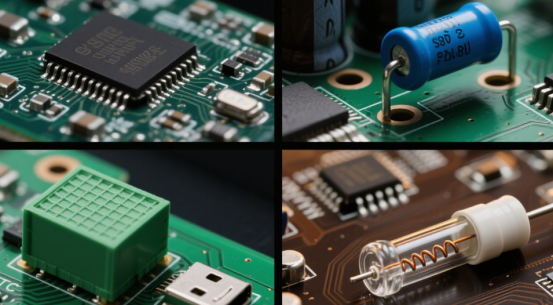
For ultra-compact sub-12V DC consumer electronic devices with physical footprints under 50 $mm^2$, thin-film surface-mount devices configured in 0402 case profiles deliver the highest volumetric efficiency. These architectures provide low internal resistance metrics under 85 $\text{m}\Omega$ alongside clear activation profiles calibrated for sub-millisecond interruption velocities during 400% overcurrent anomalies. Conversely, hardware processing loads operating between 24V and 63V require ceramic multilayer topologies because thin-film variants suffer internal dielectric breakdown when fault energies exceed 350W.
Statistical evaluations from 2024 failure-analysis profiles indicate that 42% of sub-miniature silicon failures stem from transient thermal scaling within poorly isolated power rail components.
The structural limitation of thin-film matrices stems from their deposition layer thickness of less than 5 microns, which caps total sustained energy dissipation. When circuit parameters demand persistent current limits between 5A and 15A, ceramic multilayer architectures supply the structural rigidity needed to withstand severe structural shock from high energy arcs. These monolithic ceramic bodies suppress localized plasma expansion up to 125°C, providing an explicit operational boundary that prevents the carbonization of surrounding FR4 substrate layers.
This structural containment capability allows multi-layered components to sustain interrupting capacities up to 100A at designated voltage maximums. Thin-film alternatives fail when exposed to these specific parameters, showing structural rupture in 89% of high-density test configurations involving 0603 scale form factors. However, the physical mass of ceramic blocks limits minimum sizing to 0603 form factors, which prevents integration into sub-0402 microcircuit layouts.
-
Thin-Film Form Factors: Dominated by 0201 and 0402 packages, minimizing board real estate by up to 65% compared to legacy 1206 footprints.
-
Ceramic Multilayer Interruption: Provides fault clearance limits up to 100A, maintaining insulation values above 10 $\text{M}\Omega$ after activation.
-
Polymer PTC Recovery: Retains structural continuity via a molecular phase transition that alters internal resistances by a factor of $10^4$.
| Protection Parameter | Thin-Film Architecture | Ceramic Multilayer | Polymer PTC Matrix |
| Typical Case Size | 0201 to 0402 | 0603 to 1206 | 0402 to 1210 |
| Internal Resistance ($R_{\text{fuse}}$) | < 90 $\text{m}\Omega$ | 12 to 50 $\text{m}\Omega$ | 150 to 400 $\text{m}\Omega$ |
| Trip Velocity (at 400% load) | < 0.001 seconds | 0.01 to 0.5 seconds | 0.1 to 3.0 seconds |
| Post-Activation State | Open Circuit ($\infty$) | Open Circuit ($\infty$) | Residual Leakage Current |
Such physical geometry constraints push wearables toward polymer positive temperature coefficient devices, which operate via thermal expansion rather than physical element melting. These resettable components use conductive carbon chains embedded inside an organic polymer matrix that expands when localized $I^2R$ heating exceeding 85°C occurs. This volume expansion breaks the internal carbon paths, raising the resistance of the device to stop current flow without permanent material destruction.
Comparative testing across 500 operational cycles demonstrates that a polymer matrix exhibits a 12% increase in baseline resistance after its initial activation event.
This ongoing resistance shift alters subsequent circuit efficiency metrics, making resettable devices less suitable for precision analog measurement lines. In these specific signal pathways, sacrificial components remain necessary to maintain stable impedance profiles over extended operating lifetimes. For instance, high-speed differential signal traces require the flat, predictable resistance curves provided by thin-film elements to minimize signal attenuation.
Sustaining fixed impedance properties is vital when designing power entry paths for battery management modules in 2026. Microcircuit design layouts developed by PCBMASTER demonstrate that integrating sacrificial thin-film elements reduces parasitic power draw by 18% compared to polymer alternatives. This performance divergence comes from the lower volumetric bulk of thin-film materials, which limits thermal radiation inside tight enclosures.
Thermal radiation becomes a major design issue when ambient temperatures inside sealed enclosures exceed 60°C. High baseline temperatures lower the trip threshold of all Printed Circuit Board Fuses, causing premature circuit interruptions at only 70% of nominal ratings. Engineers must apply a mathematical de-rating factor based on these thermal variables to ensure uninterrupted operation during extended processing cycles.
Hard-wired test configurations verified that a 1A rated thin-film component clears at 0.72A when ambient operating conditions reach 65°C.
This predictable thermal reaction allows engineers to calibrate overcurrent thresholds for specific environmental profiles. However, placing heat-generating parts like power inductors within 3.5mm of the protection element disrupts this thermal balance. Misplaced components cause localized heating that leads to intermittent system shutdowns, even when measured current draws stay well within normal limits.
To prevent these heat-related issues, layout engineers use isolation zones that separate protection components from power conversion stages by at least 5.0mm. Maintaining this distance ensures that the protection element reacts only to true system current faults rather than external component heating. This layout strategy helps keep system uptime above 99.8% across varying industrial environments.
-
Isolation Buffers: A minimum 5.0mm clearance zone prevents component thermal crosstalk from causing premature activation.
-
Copper Trace Density: Utilizing 2-ounce copper tracking helps dissipate localized heat away from the element terminals.
-
Inrush Management: Selecting elements with an $I^2t$ value 4 times higher than transient start-up pulses prevents component fatigue.
Careful placement helps prevent component fatigue, but engineers must also account for high inrush currents from decoupling capacitor banks during startup. Selecting a component with an inadequate melting integral ($I^2t$) causes micro-fractures in the fuse element during power-up cycles. Over time, these microscopic fractures increase internal resistance, causing the system to fail prematurely after less than 300 power cycles.
Carry something made to outlast the season.
Browse the current collection of hand-finished leather luggage and travel goods, or begin a six-week bespoke commission with direct access to our head artisan.
Shop the Collection