
925 Silver Jewelry Manufacturing for Boutique Labels
A boutique label usually opens with four to six designs at 50 pieces each, which is 200–300 units before a single reorder. The published silver minimum of 50 pieces per design is built for that scale, and the parts of the programme that make a range look like a brand — exclusivity, marking and packaging — are settled before the first casting rather than after it.

Key takeaways
- Six designs at 50 pieces is a 300-piece first collection, not a 50-piece test.
- Sampling takes 720 of the 1,440 hours in a typical programme, exactly half the calendar from brief to dispatch.
- Five packaging items per piece means 250 components for one 50-piece design.
- Exclusivity has to be written: moulds, CAD files and the collection are not resold or shown to other buyers.
What a boutique order actually is
Small does not mean simple. A 50-piece run goes through the same steps as a 5,000-piece run: model, mould, cast, file, polish, plate, inspect, pack. The difference is that each step carries less volume to absorb a mistake, so a single error spreads across a larger share of the order.
Four to six designs is the usual opening shape. At the silver minimum that is 200–300 pieces, enough to fill a web store and a market stall without holding stock for a year. Buyers who try to open with twelve designs discover that the design count, not the unit count, is what stretches the calendar.
The material decision usually splits the range. Sterling carries the pieces that need weight and a warm white tone; a diffusion line in a lower-cost metal keeps the entry price intact. The MOQ for 925 sterling silver is 50 per design, and for artisan eco-brass it is 100, so the metal choice changes the unit commitment as well as the cost per gram.
What a boutique buys at this scale is attention. A 50-piece order is small enough that a project manager can know the design by name, which is why the sample stage tends to be more detailed than the production stage that follows it.
Exclusivity is part of the product
A boutique range lives or dies on not being available two doors down. That makes design ownership a commercial term rather than a legal footnote. The published position is a 100% NDA, with designs treated as 100% exclusive and moulds, CAD files and the collection not resold or shown to other brands.
Ask what happens at the end of the relationship. Does the mould stay in storage, move to the buyer, or get destroyed? A mould that stays with the factory can be run again for someone else unless the contract says otherwise, and a CAD file is easier to reuse than a physical tool.
Ask whether the piece can appear in the factory's portfolio. Most buyers accept a photograph after launch and refuse it before; the distinction should be stated, because a supplier's marketing page is a public disclosure of a design that has not shipped yet.
This is the practical difference between developing a collection and buying from a catalogue. Catalogue goods are available to every buyer; developed goods are not, provided the paperwork matches the promise. For a label whose value sits in the design, that clause is worth more than a discount on the first run.
Metal choice interacts with exclusivity. A brand that wants the same silhouette in a cheaper metal for a diffusion line can carry the design into custom brass jewelry without opening the design to other buyers, as long as the exclusivity clause covers the collection rather than a single SKU.
Packaging is where the range becomes a brand
Five items are listed for private-label orders: metallic logo tags, foil-stamped gift boxes, velvet or microfiber pouches, display backing cards and barcode labelling. Each is a separate purchase with its own lead time, and each one has to match the piece it holds.
The backing card is the most visible in a retail setting, because it carries the logo at eye level before the jewelry is handled. The pouch decides what a customer sees first at home. The barcode label is the least glamorous and the most operational: without it, a stockroom cannot reconcile a 300-piece range against a sales report.
Logo tags and boxes are usually where a small brand spends disproportionately, and where the mismatch shows. A foil-stamped box with a plain pouch reads as two different brands in the same parcel. Ordering all five items against one colour reference and one logo file prevents that, and it costs less than reprinting a box run.
Packaging also consumes calendar. Print and foil work sits outside the jewelry production window, so a launch date that assumes packaging arrives with the goods is usually wrong by a week or two. Brief both streams on the same day.
The critical path for a first collection
Six stages run in sequence, and two of them can run in parallel. The table shows where a boutique label actually spends its weeks, with the published windows used as the base.
| Stage | Published window | What the label does |
|---|---|---|
| Brief and CAD | Under 48 hours | Approve dimensions, weight, stone sizes and marks |
| Master sample | 25–30 days | Test fit, finish and clasp, then approve in writing |
| Packaging artwork | Runs alongside sampling | Order tags, boxes, pouches, cards and labels |
| Bulk production | 3–4 weeks | Confirm quantities per design and per size |
| Final QC and delivery | 100% inspected | Check counts, marks and packaging match |
The parallel row is the one small brands miss. Packaging artwork can be approved while the sample is still on the bench, which removes two or three weeks from the launch. Waiting for the finished piece before ordering boxes adds those weeks back at the end, when there is no room left to absorb them.
The QC row matters more at boutique scale than at volume. A 300-piece order inspected at 100% means every piece is checked, so a missing tag or a wrong barcode is caught before it reaches a customer who will photograph it.
Worked example
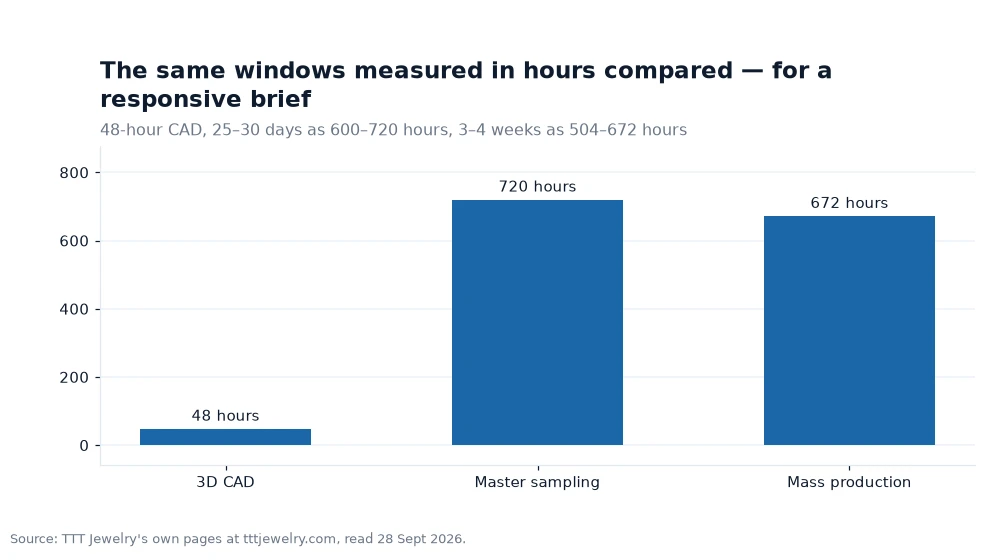
Convert the windows into hours. CAD at 48 hours is 48. Sampling at 30 days is 30 × 24 = 720 hours. Production at 28 days is 28 × 24 = 672 hours. The total is 48 + 720 + 672 = 1,440 hours, and 1,440 ÷ 24 = 60 days, or 60 ÷ 7 = 8.6 weeks.
Sampling's share of that total is 720 ÷ 1,440 = 50%. CAD is 48 ÷ 1,440 = 3.3%. So half the calendar sits in one stage, and the two decisions that protect it are a complete CAD brief and a written approval at the end.
Packaging arithmetic runs on units instead. At 50 pieces per design and five items per piece, one design needs 5 × 50 = 250 components. Six designs at 50 pieces is 300 pieces and 6 × 250 = 1,500 components to order, count and match — a logistics task that belongs on the same calendar as the casting.
Frequently asked questions
Can a boutique label order fewer than 50 pieces per design?
The published silver minimum is 50 pieces per design, so a smaller first order means fewer designs rather than fewer units of each design.
Who owns the mould after the order finishes?
Designs are stated as exclusive, with moulds, CAD files and the collection not resold or shown to other buyers, and the storage or transfer of the tool should be written into the agreement.
Does packaging arrive with the jewelry?
It can, but print and foil work runs on a different schedule, so packaging should be briefed at the same time as the sample to land before the goods.
Launching a small range without losing the calendar
The sequence that holds is brief, sample, approval, production, inspection. Every shortcut around the approval step returns as a rework, and at 50 pieces a rework consumes a visible share of the order.
For a label that intends to grow into other metals, the stainless steel jewelry manufacturer route offers a second price tier with PVD plating, while the design language stays in one place.
Keep the sample, the approved CAD and the packaging proofs in one folder. A second collection is built from those three documents far more often than from a new brief.
Source note: figures come from the manufacturer's own website (tttjewelry.com), read 28 Sept 2026.[1]